Table of Contents
- Introduction
- The Uncomfortable Truth About White-Hat SEO
- Content Strategies That Make Journalists Look Smart
- Outreach That Does Not Belong in the Spam Folder
- Technical Wins for the Resource-Strapped Founder
- Community Infiltration Without Being Annoying
- Measuring ROI Without Obsessing Over Vanity Metrics
- Frequently Asked Questions
Key Takeaways
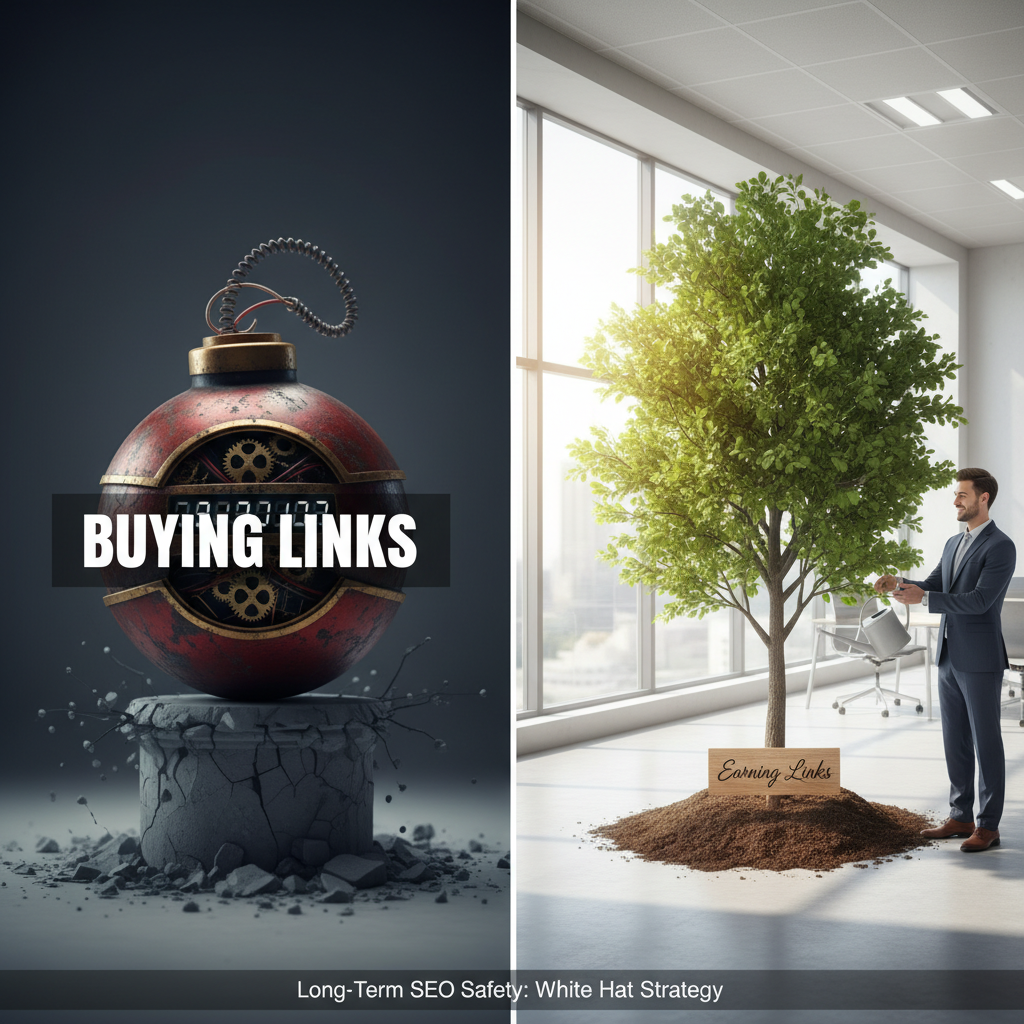
- Safety First: White-hat strategies focus on long-term sustainability and protecting your domain from Google penalties, unlike “black-hat” shortcuts that act as a ticking time bomb.
- Value Over Volume: One link from a highly relevant, authoritative industry publication is worth infinitely more than hundreds of low-quality directory submissions.
- Data is Currency: Original research and unique data visualization are the most reliable ways to earn passive backlinks from journalists and bloggers.
- Relationships Matter: Successful link building for startups is less about technical manipulation and more about digital PR and genuine community engagement.
Introduction
Let’s address the elephant in the server room immediately: most startups are invisible to Google, and it is driving their founders insane. You have built a product that disrupts the status quo, your UI is sleek, and your code is clean, yet your organic traffic flatlines. The harsh reality of the digital ecosystem is that Google does not care how innovative your startup is if nobody else is vouching for it. In the eyes of a search engine, a website without backlinks is like a politician without endorsements—isolated, untrusted, and unlikely to win any elections.
However, the desperation to fix this problem often leads founders down a dark path. The myth that “if you build it, they will come” has destroyed more burn rates than bad product-market fit. Founders panic and turn to shady freelance marketplaces, buying “500 High DA Links” for fifty bucks, thinking they have hacked the system. They haven’t. They have just purchased a one-way ticket to the Google penalty box. We aren’t here to discuss those spammy tactics. We are here to talk about survival, authority, and the kind of link building that builds a moat around your business.
This guide focuses exclusively on white-hat strategies—techniques that adhere to search engine guidelines and focus on human value. But let’s be clear: “white-hat” does not mean “passive” or “boring.” It requires aggression, creativity, and a willingness to create content that is significantly better than what currently exists. We are moving away from the mindset of begging webmasters for favors and toward a strategy of earning citations because your startup is simply too interesting to ignore.
The Uncomfortable Truth About White-Hat SEO
Why Google Hates Your Shortcuts
There is a pervasive temptation in the startup world to treat SEO like a growth hack that can be solved with a credit card. Buying links seems like a logical shortcut. After all, if links are votes, why not just buy the votes? The problem is that Google’s engineers are significantly smarter than the average SEO “guru” selling link packages. Algorithms like Penguin were specifically designed to detect unnatural link patterns. When you buy links from a private blog network (PBN) or a link farm, you are essentially planting a ticking time bomb in your domain’s history. It might work for a month, or maybe even six, but eventually, the detonation will occur.
When that bomb goes off, the damage is often irreversible for a young company. A manual penalty or an algorithmic suppression can erase a startup’s digital existence overnight. Imagine waking up to find that your brand name doesn’t even rank for itself. For a startup relying on organic growth to lower customer acquisition costs, this is a death sentence. Google explicitly warns against link schemes in their official documentation, noting that any behavior that manipulates links to your site or outgoing links from your site is a violation. The risk-to-reward ratio for black-hat tactics is simply too high for a legitimate business building a real brand.
Furthermore, the “shortcuts” often rely on metrics that are easily manipulated. Many founders obsess over “Domain Authority” (DA) or “Domain Rating” (DR), third-party metrics that Google doesn’t actually use. Spammy link sellers artificially inflate these numbers to trick buyers. You end up paying for a high-number score on a third-party tool that translates to zero actual ranking benefit on Google. It is a vanity metric ecosystem designed to separate naive founders from their marketing budget.
The Difference Between Earning and Begging
To succeed in white-hat link building, you must undergo a fundamental mindset shift from “give me a link” to “here is value.” The “begging” mindset involves cold emailing hundreds of people with a generic template asking them to link to your homepage just because you exist. This has a success rate hovering near zero and annoys everyone involved. The “earning” mindset, conversely, asks a different question: What can I create that makes another writer’s job easier? When you provide value, the link becomes a byproduct of the transaction, not the sole focus.
Sustainable links come from being a citation-worthy source. This means your content needs to serve as a reference point. Think about Wikipedia; people link to it because it explains concepts clearly and authoritatively. Your startup needs to become the Wikipedia of its specific niche. Whether that is through comprehensive guides, free tools, or unique data, the goal is to be the resource that other people cite to support their own arguments. This builds authority through expertise rather than the volume of spam emails sent.
This shift also changes how you view your content marketing. You are no longer just writing for your potential customers; you are writing for the “linkrati”—the journalists, bloggers, and influencers who control the websites that can pass authority to you. If you want to dive deeper into how to structure your content for this dual audience, checking out a guide on winning SEO content marketing strategies is highly recommended. You have to write content that industry peers respect enough to share.
Why Startups Have a Unique Advantage
Believe it or not, being a small startup is actually an advantage in the link-building arena. Enterprise competitors are bogged down by compliance departments, legal reviews, and brand safety guidelines that turn their content into flavorless mush. They cannot take a stand, they cannot be controversial, and they move at a glacial pace. A startup, however, can be agile. You can newsjack a trending topic within hours. You can publish a polarizing opinion piece that challenges industry norms. This agility allows you to capture attention in ways that big corporations simply cannot.
Founders can also leverage their personal brands much more effectively than faceless corporations. A founder telling a raw, honest story about failure or sharing transparent revenue numbers is “link-bait” gold. People love to link to human stories, not corporate press releases. By positioning the founder as a thought leader, you open up opportunities for interviews, podcasts, and guest contributions that naturally result in high-quality backlinks.
Additionally, modern startups often have access to unique proprietary data. If your SaaS tool processes user behavior, you have a goldmine of potential statistics. You can harvest this data (anonymized, of course) to reveal trends that no one else sees. While the big competitors are sitting on data silos, you can publish a report on “The State of X Industry” based on real-time usage. This unique data creates a monopoly on information, forcing anyone who wants to discuss the trend to link back to you as the primary source.
Content Strategies That Make Journalists Look Smart
Original Research is Your Best Moat
Journalists and content creators are constantly under pressure to produce credible content on tight deadlines. They are desperate for data to support their narratives and validate their headlines. If you can provide that data, you become their best friend. Original research is the single most effective white-hat link-building strategy because it provides something that cannot be easily replicated. It creates a “moat” around your content—competitors can copy your opinion, but they cannot copy your proprietary data without citing you.
This doesn’t require a Ph.D. research team. You can run a simple survey using tools like SurveyMonkey or Typeform, targeting a few hundred people in your industry. Ask them burning questions about their pain points, salaries, or tech stacks. Compile the results into a clean, easy-to-read report. For example, if you are in the HR tech space, a report on “Remote Work Burnout Rates in 2025” would be catnip for major publications like Forbes or TechCrunch. They will write articles about your findings and link to you as the source of the study.
Another approach is to analyze internal user data. If you run an email marketing startup, publish data on “The Best Time to Send Emails” based on the millions of emails processed through your platform. This data is unique to you. When you publish this, you aren’t begging for links; you are distributing knowledge. Other blogs will reference your specific stats (“According to [Startup Name], 10 AM is the best time…”) because it adds credibility to their own writing.
The “Ego-Bait” Strategy That Actually Works
Flattery gets you everywhere, especially in SEO. The “ego-bait” strategy involves creating content that features other experts, influencers, or companies, with the hope that they will share the content and link to it. The psychology is simple: everyone likes to be recognized as an authority. However, this strategy has been abused with low-effort “expert roundups” that provide zero value. To make this work today, the content quality must justify the share.
One effective method is the “Top X Tools” or “Best X Resources” list, but with a twist. Don’t just list them; write glowing, detailed reviews of the non-competing tools you want to court. Once the article is live, reach out to them personally. “Hey, we just featured [Tool Name] as one of the best CRM integrations for 2025 because we love your UI. Here is the link.” A significant percentage will add the link to their “Press” page or share it on social media. It builds goodwill and relationships that can be leveraged for future collaborations.
Another high-value tactic is the deep-dive interview. Instead of asking generic questions, do your homework and ask profound questions that allow the expert to show off their intelligence. When the interview is published, they are highly likely to link to it from their personal site or LinkedIn. This leverages their distribution network to boost your domain authority. If you are looking for more ways to enhance your content visibility, reading up on future trends in SEO can give you ideas on how to position these interviews.
Visual Assets That Get Stolen (In a Good Way)
Humans are visual creatures, and the internet is a visual medium. However, most bloggers are terrible at graphic design. They write great text but struggle to create engaging visuals. If you can create high-quality infographics, charts, or diagrams that simplify complex industry concepts, you create an asset that is destined to be “stolen.” In the SEO world, having your image stolen is a good thing, provided you get attribution.
Create a diagram that explains a complicated process in your niche. For example, a fintech startup could create a flowchart explaining “How a Mortgage Approval Works.” When other bloggers write about mortgages, they will search for an image to break up the text. They will find your diagram, embed it in their post, and (usually) add a source link underneath. This is passive link building at its finest. You do the work once, and the asset continues to earn links for years.
To supercharge this, you can perform a reverse image search on your own assets using Google Images. If you find websites that have used your infographic but didn’t link back to you, it’s an easy win. You simply email them: “Hey, I saw you used our mortgage flowchart on your excellent post about real estate. I’m glad you found it useful! Could you mind adding a quick source link so your readers know where the data came from?” The conversion rate on these requests is incredibly high because they are already using your value.

Outreach That Does Not Belong in the Spam Folder
Why Generic Guest Posting is Dead
Guest posting was once the golden child of link building, but it has been beaten into submission by spammers. Editors at major publications receive hundreds of emails a day with subject lines like “High Quality Guest Post for Your Site.” They delete them without opening them. To succeed with guest posting in 2025, you have to realize that the generic approach is dead. You cannot outsource this to a $5/hour VA who uses a template.
Success now requires extreme personalization and relevance. You should focus on high-relevance niche publications rather than just chasing high Domain Authority. A link from a boutique blog that covers your exact industry is worth more than a link from a generic business site. When pitching, you must pitch a specific angle that challenges or complements their existing content. Show them you have actually read their blog. “I loved your piece on X, but I think you missed the angle of Y…”
Furthermore, the content you submit must be better than what you publish on your own site. It needs to be your best work. If you send an editor a thin, keyword-stuffed article, you burn that bridge forever. But if you send a data-backed, insightful piece that drives traffic to their site, they will welcome you back. It is about building a relationship with the editor, not just extracting a link.
Mastering Digital PR and HARO
One of the most potent tools in a startup’s arsenal is “Help A Reporter Out” (HARO), now often part of platforms like Connectively or Qwoted. These platforms connect journalists who are writing stories with experts who can provide quotes. Major outlets like The New York Times, Wall Street Journal, and industry trades use these services daily to find sources. By positioning your founder or head of product as an expert commentator, you can earn links from the most authoritative sites on the internet.
The key to winning at Digital PR is speed and specificity. When a query comes in relevant to your niche, you need to reply within thirty minutes. Journalists are on tight deadlines; the first usable quote often wins. Do not send a press release or a sales pitch. Send a direct, quotable answer to their question. Provide your credentials in one sentence to establish authority. If you can become a reliable source who provides soundbites that are ready to print, journalists will start coming to you directly.
Digital PR also involves monitoring the news cycle. If a major regulation changes in your industry, write a response or an analysis immediately. Distribute this to industry journalists. You are essentially doing their homework for them by synthesizing what the news means. This positions your startup as a thought leader and generates high-quality editorial backlinks that money literally cannot buy.
The Art of the “Value-First” Pitch
Cold outreach is uncomfortable, but it works if you flip the script. Instead of asking for a favor immediately, offer value first. This is the concept of Reciprocity. One effective tactic is to audit the prospective site for errors before you reach out. If you find a broken image, a formatting error, or a typo on a high-traffic page, point it out politely. “Hey, I was reading your great guide on X and noticed the image in section 3 is broken. Just wanted to let you know!”
By leading with help, you differentiate yourself from the 99% of leechers in their inbox. You establish yourself as a helpful human being, not a bot. Once they reply to thank you, you have opened a dialogue. You can then transition naturally: “By the way, I actually wrote a piece that expands on the topic in that same section…” The psychological urge to return the favor increases your success rate dramatically.
Another angle is to offer a fresh perspective on a stale topic they covered recently. If they wrote about “Trends in 2023,” email them and say, “I see you covered 2023 trends. We just released some data on what’s shifting for 2025. Would you be interested in seeing it for a potential update to the post?” You are helping them keep their content fresh and relevant, which is a service to them. In exchange, you get the citation.
Technical Wins for the Resource-Strapped Founder
Turning Unlinked Mentions into Gold
As your startup grows, people will start talking about you. They might mention your brand name, your product, or your founder in a blog post or news article. However, often due to laziness or oversight, they won’t include a clickable hyperlink. These are known as “unlinked mentions,” and they are the lowest-hanging fruit in the SEO world. The hard part—getting the coverage—is already done. You just need to close the loop.
Set up alerts for your brand name using tools like Google Alerts (free) or Ahrefs (paid). When you get a notification that you’ve been mentioned, check the article. If there is no link, hunt down the author’s email or contact form. Send a polite, low-pressure note: “Thanks so much for the shoutout in your recent article! I really appreciated the coverage. Would you mind making the brand name a clickable link so your readers can find us easily?” Most authors are happy to oblige because it improves the user experience for their readers.
This strategy has one of the highest conversion rates because the author clearly already likes your brand enough to write about it. It’s a gentle nudge rather than a cold pitch. Ensure you are monitoring variations of your brand name and key executives’ names as well to capture every opportunity.
The Broken Link Building Hustle
Broken link building is the digital equivalent of being a helpful janitor. The web is full of “link rot”—pages that have been deleted, sites that have gone offline, and resources that have moved. This creates a bad user experience for the sites linking to them. Your job is to find these broken links on relevant industry blogs and offer your content as a replacement.
First, identify a high-quality resource page or blog post in your niche. Use a broken link checker tool to scan the page for 404 errors. When you find a broken link, check what the content used to be (using the Wayback Machine). If you have similar (or better) content, you are in business. If not, create a piece of content specifically to fill that gap. This is highly targeted content creation.
Then, reach out to the site owner: “I was browsing your resources page and noticed that the link to [Old Resource] is returning a 404 error. I actually have a similar guide here [Your Link] that might make a good replacement so your visitors don’t hit a dead end.” You are helping them fix their site quality, and in return, you get a backlink. It’s a classic win-win scenario that relies on service rather than solicitation.
Reclaiming Lost Link Equity
Startups iterate quickly. You change URL structures, you delete old product pages, and you pivot marketing strategies. In this chaos, you often accidentally break your own backlinks. If a high-authority site links to `yourstartup.com/blog/old-post` and you delete that post, that backlink is now hitting a 404 wall. All the “link juice” (authority) that was passing to your site is evaporating into the ether.
Regularly audit your own backlink profile to find incoming links pointing to 404 pages on your site. This is crucial technical hygiene. When you find them, you have two options: restore the page, or, more likely, set up a 301 redirect to the most relevant existing page. This tells Google, “The content has moved here,” and preserves the authority of that backlink.
Using AI tools can help automate the detection of these issues. If you want to future-proof your strategy, consider how AI for SEO can assist in monitoring these technical elements. Every backlink you have earned is an asset; letting them break is like throwing money in the trash. Reclaiming them is the fastest way to boost your authority without needing to pitch a single new person.
Community Infiltration Without Being Annoying
Leveraging Niche Forums and Quora
Community marketing on platforms like Reddit, Quora, and IndieHackers is a delicate art. These communities are incredibly hostile to blatant self-promotion. If you drop a link and run, you will be downvoted into oblivion. However, if you genuinely participate, these platforms can be powerful drivers of traffic and signals to Google. The goal is to build a reputation as a helpful expert.
Look for threads asking questions that your product or expertise solves. Write a detailed, helpful answer that solves 90% of the user’s problem right there in the thread. Do not force them to click to get the answer. Then, and only then, include a link at the bottom or within the context: “I wrote a more detailed breakdown of this process here if you need more info.” Because you provided value upfront, the link is viewed as a resource rather than spam.
Over time, these threads rank in Google themselves. A link from a high-ranking Quora answer can drive consistent referral traffic for years. It’s about playing the long game. Treat these communities like a cocktail party; listen, contribute to the conversation, and only talk about yourself when it’s relevant.
Local Listings and Industry Directories
Even if you are a digital-only SaaS startup with no physical storefront, local SEO signals can still help establish trust and entity authority. Getting listed in reputable local directories like Google Business Profile (if eligible), Yelp, or your local Chamber of Commerce creates a foundational layer of citations. These links verify that you are a real business with a real address and phone number.
Beyond local, look for niche-specific directories. If you are a B2B software company, profiles on G2, Capterra, and Crunchbase are mandatory. These are high-authority domains that Google trusts implicitly. Unlike spammy general directories, these sites require verification. They build your “Entity” profile in Google’s Knowledge Graph.
Ensure your NAP (Name, Address, Phone) data is consistent across all these listings. Inconsistencies can confuse search engines. While these links might not be the most powerful individually, collectively they provide a “trust signal” that validates your more aggressive link-building efforts. For a broader view on how to get noticed, check out this guide on getting your practice on Google, which applies to many local and service-based startups.
The Podcast Circuit Strategy
Podcasting is the new guest blogging. There are thousands of podcasts in every niche hungry for guests. Pitching your founder to appear on relevant podcasts is a fantastic way to build links. Almost every podcast has a website where they publish “Show Notes” for each episode. These show notes invariably include a link to the guest’s website and their social profiles.
These links are often high-quality and contextually relevant. Plus, the barrier to entry is often lower than getting a guest post published on a major blog. You just need a decent microphone and an interesting story. The added benefit is that the audio content drives brand awareness and referral traffic. Listeners who hear you speak for 45 minutes develop a much deeper connection with your brand than someone scanning a blog post.
Treat the podcast host as a partner. Promote the episode heavily to your own audience. If you help them get downloads, they will be more likely to recommend you to other podcast hosts, creating a flywheel effect of interviews and backlinks.
Measuring ROI Without Obsessing Over Vanity Metrics
Domain Authority is a Guide, Not a Goal
It is time to deprogram yourself from the cult of Domain Authority (DA). DA is a metric invented by Moz (and DR by Ahrefs) to predict how well a site might rank. It is not a Google ranking factor. A link from a site with DA 20 that is hyper-relevant to your industry is often more valuable than a link from a DA 80 site that has nothing to do with your niche. Relevance is the new PageRank.
Startups often burn budget chasing high-DA links from generic news sites, ignoring the smaller, passionate blogs in their ecosystem. Google’s algorithms have evolved to understand semantic relevance. If you sell coffee software, a link from a coffee bean blog is gold, even if that blog is small. Stop filtering your outreach lists purely by DA numbers. Look for engagement, content quality, and topical alignment.
Tracking Referral Traffic Quality
The best link is one that brings customers, not just robots. When analyzing the success of your link-building campaign, look at your analytics. How much referral traffic is a specific backlink driving? More importantly, what is that traffic doing? Are they bouncing immediately, or are they signing up for your trial?
If a guest post on a high-profile site drives 500 visitors but zero conversions, and a comment on a niche forum drives 50 visitors and 5 conversions, the forum link was the better business investment. SEO is ultimately a marketing channel, and marketing is about revenue. Good links bring qualified leads. If you are building links solely for the “link juice” without considering the human element, you are missing half the picture.
Keyword Ranking Correlations
Finally, the ultimate lagging indicator is your organic search performance. You should track the rankings of specific pages that you are building links to. If you build 10 high-quality links to your “Ultimate Guide to X” and three weeks later it jumps from position 15 to position 4, your strategy is working.
Be patient. Link effects are not instantaneous. It can take Google weeks or even months to fully recrawl and recalculate the value of new links. Look for the correlation between your outreach efforts and your organic traffic growth over a quarterly basis. If the trend line is moving up and to the right, keep going. If it’s flat, re-evaluate the quality and relevance of the links you are acquiring.

Book a free consultation for your practice today.
Frequently Asked Questions
Is guest blogging still effective in 2025?
Yes, but the strategy has shifted. You must target reputable sites with strict editorial standards. If a site openly advertises “Write for Us” or sells posts for $50, avoid it. Effective guest blogging is about legitimate thought leadership on relevant industry publications, not mass-producing content for link farms.
How much should a startup budget for link building?
In the early stages, you should budget time rather than money. Founder-led outreach and content creation are more effective than hiring a cheap agency. As you scale, avoid “cheap” link packages (e.g., $100 for 10 links); these are dangerous. A legitimate agency or PR firm focusing on white-hat outreach will typically cost several thousand dollars per month due to the labor intensity of real relationship building.
What is the difference between white-hat and black-hat?
White-hat SEO follows Google’s Webmaster Guidelines, focusing on creating value for users and earning editorial links. Black-hat SEO attempts to trick or manipulate the search algorithms using tactics like buying links, cloaking, or using private blog networks. White-hat is a long-term investment; black-hat is a high-risk gamble.
How long does it take to see results?
SEO is a marathon, not a sprint. While technical fixes can show results quickly, authority building through links typically takes 3 to 6 months to show significant impact on rankings. Consistency is key; a steady trickle of high-quality links is better than a sudden spike followed by silence.
Can I do link building with zero budget?
Absolutely. The most effective strategies—HARO, broken link building, and creating data-driven content—cost sweat equity, not cash. Using free tools like Google Alerts, Google Sheets, and manual email outreach allows any startup to build a formidable backlink profile without spending a dime on agencies.