You’re probably looking at three tabs right now: an AI logo maker, a freelancer marketplace, and a few agency sites with pricing that feels built for companies much larger than yours. Meanwhile, your pitch deck needs a mark, your website header looks unfinished, and every design choice suddenly feels more permanent than you expected.
That pressure is normal. Founders often treat the logo like a box to check quickly, then discover it affects almost every public-facing moment that follows. It shows up in investor decks, browser tabs, social profiles, packaging, proposals, and sales materials long before your company has much room for error.
A strong startup logo doesn’t have to come from the most expensive route. It does need a strategy behind it, a clear standard for quality, and file formats that won’t create problems later. The right approach is usually not “spend the least” or “spend the most.” It’s making smart trade-offs at the stage you’re in.
Why Your Startup Logo Is More Than Just a Pretty Picture
A founder walks into a pitch with a solid product and a weak visual identity. The logo came from a quick generator, the typography doesn’t match the deck, and the icon looks suspiciously similar to five other startups in the category. Investors may not say, “the logo lost the room,” but they do notice when the brand presentation feels unfinished.
That’s because a logo isn’t decoration. It’s a shorthand for judgment. People use it to decide whether your company feels established, credible, current, and worth a second look.

The business case is stronger than many founders realize. Startups with a cohesive brand identity, including professional logo design, are 2.5 times more likely to receive funding, according to Harvard Business Review research analyzing over 200 institutional investors, as cited by Crea8ive Solution’s roundup on professional logo design for startups.
What the logo is actually doing
Your logo has a job long before customers know your story.
- It frames first impressions: Before anyone reads your copy, they read your visual standards.
- It signals seriousness: A polished mark tells buyers, partners, and investors that you pay attention to detail.
- It carries memory: People won’t remember every sentence in your deck. They will remember a clear visual system.
Practical rule: If your logo only works when it’s large, full color, and surrounded by explanation, it’s not ready for startup use.
Founders sometimes push logo work to the end because it feels less urgent than product or sales. In practice, it touches both. The logo isn’t your whole brand, but it is often the first visible proof that your startup knows how it wants to be seen.
The Logo Strategy Blueprint Before You Design
Most weak startup logos don’t fail in Illustrator or Figma. They fail in the brief. If the founder can’t clearly describe the company’s personality, audience, and market position, the final design ends up vague, generic, or overworked.
Before you hire anyone or open a logo maker, do the homework.
Define the brand personality
A startup logo should reflect a point of view, not just a service category. “Professional” isn’t enough. So is every competitor trying to look professional.
Get specific with the words you use internally. Are you technical or human? Premium or accessible? Fast-moving or steady? Conservative or disruptive? You don’t need a brand workshop that lasts all week. You do need a clear direction.
Ask yourself:
- What should people feel: Trust, momentum, calm, authority, optimism?
- What should they never feel: Cheap, confusing, cold, playful, dated?
- What kind of company are you becoming: A niche specialist, a broad platform, a regional expert, a national brand?
A good logo brief often includes contrast statements. “We want to feel modern, but not trendy.” “We want to feel credible, but not corporate.” Those distinctions help a designer make better decisions faster.
Know the audience you’re trying to reassure
Founders often say, “Our product is for everyone.” The logo suffers when that happens. A mark for procurement teams looks different from one aimed at indie creators. A B2B legal tech startup shouldn’t borrow the visual language of a direct-to-consumer wellness brand.
Think about who has to trust you first.
| Question | Why it matters |
|---|---|
| Who sees the logo first? | Investor, buyer, hiring candidate, channel partner |
| Where do they see it? | Pitch deck, website, app icon, proposal, packaging |
| What are they worried about? | Risk, credibility, price, complexity, reliability |
If your audience is cautious, clarity matters more than cleverness. If they’re choosing among many similar products, differentiation matters more.
A useful brief doesn’t say, “Make it pop.” It says, “Our buyers need to feel that we’re reliable enough for a serious contract and modern enough not to be outdated.”
Study the market without copying it
Competitive review isn’t about mood boards full of logos you like. It’s about finding patterns you should follow, and patterns you should avoid. Pull logos from direct competitors, adjacent brands, and larger companies your audience already trusts.
Look for repetition. If every fintech startup in your set uses a blue abstract symbol and geometric sans serif type, copying that language might help you fit in, but it won’t help you stand out. Sometimes the smarter move is to keep the category signal in the typography and create distinction in the mark. Sometimes it’s the opposite.
Write short notes on each competitor:
- What looks credible
- What feels overused
- What seems dated
- What visual territory is still open
If you need help turning that thinking into a broader system, this guide on how to create a brand identity is a useful next step. The logo works better when it’s part of a deliberate identity, not a one-off graphic.
Essential Logo Design Principles for Maximum Impact
Founders don’t need to become designers, but they do need a good filter for judging concepts. Without that filter, feedback turns into “make it bolder” and “can we try a cooler font,” which usually makes the work worse.
The strongest logo design for startups tends to hold up against five tests.
Simplicity and memorability
Simple doesn’t mean bland. It means the idea is clear enough to recognize quickly and remember later. Airbnb, Slack, and other well-known tech brands didn’t become recognizable because their logos were visually busy. They became recognizable because the core shapes were controlled and repeatable.
If a mark needs intricate detail to feel interesting, it usually won’t survive real-world use. App icons, favicons, profile images, and slide footers punish complexity.
A practical test is to shrink the logo until it’s tiny. If the concept disappears, blurs together, or turns into an unrecognizable shape, simplify it.
Versatility and color discipline
A startup logo has to work in more than one environment. It should hold up in black and white, on light backgrounds, on dark backgrounds, inside a social avatar, and in a narrow website header.
Color matters, but restraint matters more. Colored logos can boost brand recognition by up to 80%, and 95% of the top 100 global brands use only one or two colors for simplicity and versatility, according to Huddle Creative’s logo statistics roundup.
That’s useful guidance for founders who want to keep adding accent colors, gradients, and effects. The more environments your logo needs to survive, the more valuable a limited palette becomes.
Quick evaluation checklist
- One-color test: Does it still look intentional in solid black?
- Small-size test: Can you identify it at favicon scale?
- Dark-mode test: Does it remain legible on dark backgrounds?
- No-explanation test: Would a stranger understand the brand tone without context?
A short visual explainer can help sharpen your eye before you review concepts:
Timelessness and appropriateness
A logo shouldn’t chase the visual trend of the month. Trend-heavy marks age fast, especially for startups that need a few years of consistent recognition before they earn the luxury of a redesign.
Appropriateness matters just as much. A cybersecurity startup can be modern without looking playful. A family-focused service can feel warm without looking childish. The right logo style is the one that fits your audience, offer, and ambition, not the one that earns the most compliments in a vacuum.
A strong logo doesn’t scream for attention. It earns recognition through repeated, consistent use.
Navigating Your Logo Design Options and Process
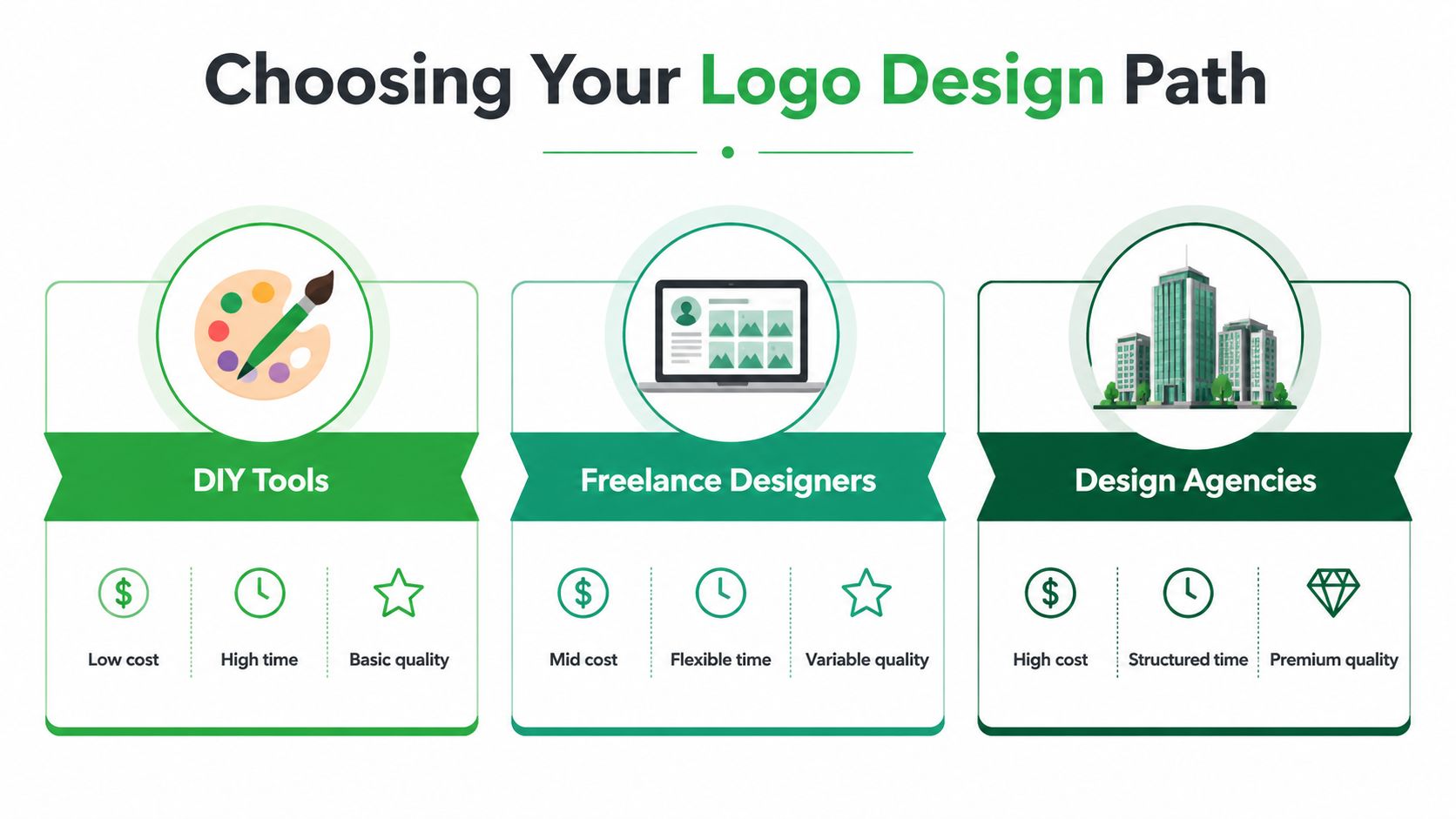
Most founders choose between three paths. They use a DIY tool, hire a freelancer, or work with an agency. None is automatically right or wrong. The best choice depends on how much strategy you need, how quickly you need the work, and whether this logo has to support more than a website launch.
Comparing the three paths
| Option | Best for | Strengths | Trade-offs |
|---|---|---|---|
| DIY tools | Very early testing | Fast, low cost, immediate drafts | Generic output, weak differentiation, limited strategy |
| Freelancer | Founders with a clear brief | Flexible, often more custom, direct collaboration | Quality varies, process varies, file handoff may be uneven |
| Agency | Startups tying logo to broader launch assets | Stronger process, strategy, system thinking | Higher investment, more structured timeline |
DIY tools can be useful if you need a temporary mark for a prototype or internal deck. They become risky when founders mistake speed for readiness. You can make something that looks polished enough on a laptop screen but breaks down once it hits print, packaging, or a sales document.
Freelancers can be an excellent middle ground. The key is vetting. Review their portfolio for consistency, not just one standout project. Ask what files they deliver, how revisions work, and whether they can think beyond the mark itself.
An agency becomes more practical when the logo has to connect with a website, brand identity, pitch materials, social graphics, or printed collateral. X8 Web Design is one example of that broader service model. It handles logo and branding work alongside websites, collateral, and launch assets, which can reduce handoff issues when a startup needs the identity applied across multiple touchpoints.
The hidden cost of inconsistency
A logo doesn’t fail only because the mark is weak. It also fails when the startup applies it inconsistently. A 2025 analysis notes that 70% of startups rebrand within 2 years due to inconsistent visuals across touchpoints, yet only 20% invest in full identity packages upfront, according to FZP Digital’s analysis of logo design for startups.
That trade-off shows up all the time. A founder saves money on the initial logo, then spends time patching together profile images, deck templates, proposal pages, signage, and social headers with no real system behind them.
What a professional process should look like
Even if your budget is modest, the process should still be structured.
-
Brief and discovery
The founder defines audience, brand tone, competitors, and usage needs. -
Concept development
The designer explores more than one viable route instead of polishing the first idea too early. -
Review and revision
Feedback focuses on fit, clarity, and usability. Not personal preference alone. -
Refinement
One concept gets developed into a logo system with variants. -
Final delivery
Files arrive in formats you can use across web, print, and product needs.
For physical branding, don’t stop at screen use. If the logo may appear on caps, uniforms, or merch, review whether the design can create embroidery-ready designs for headwear. Fine detail, thin strokes, and delicate gradients often need adjustment before they work in stitched form.
The right process saves money by preventing avoidable redesigns. The wrong process saves money only on day one.
Decoding Logo Pricing and Final Deliverables
Founders often ask what they’re paying for. The honest answer is that they’re paying for judgment, process, originality, and usable assets, not just a symbol on a white background.
A cheaper option can still be the right choice if your use case is narrow and temporary. But if the logo has to function across sales, web, social, print, merch, and investor materials, the deliverables matter as much as the design itself.
What usually drives the price
Higher-quality logo work typically includes more of the following:
- Strategic thinking: Positioning, market review, and concept rationale
- Originality: Custom mark development instead of stock assembly
- Revision discipline: Thoughtful rounds of refinement
- System thinking: Variants for different placements and backgrounds
- Clean handoff: Organized files with naming and usage logic
Low-cost options often remove one or more of those layers. Sometimes that’s fine. Sometimes it creates expensive cleanup later.
The files you should insist on
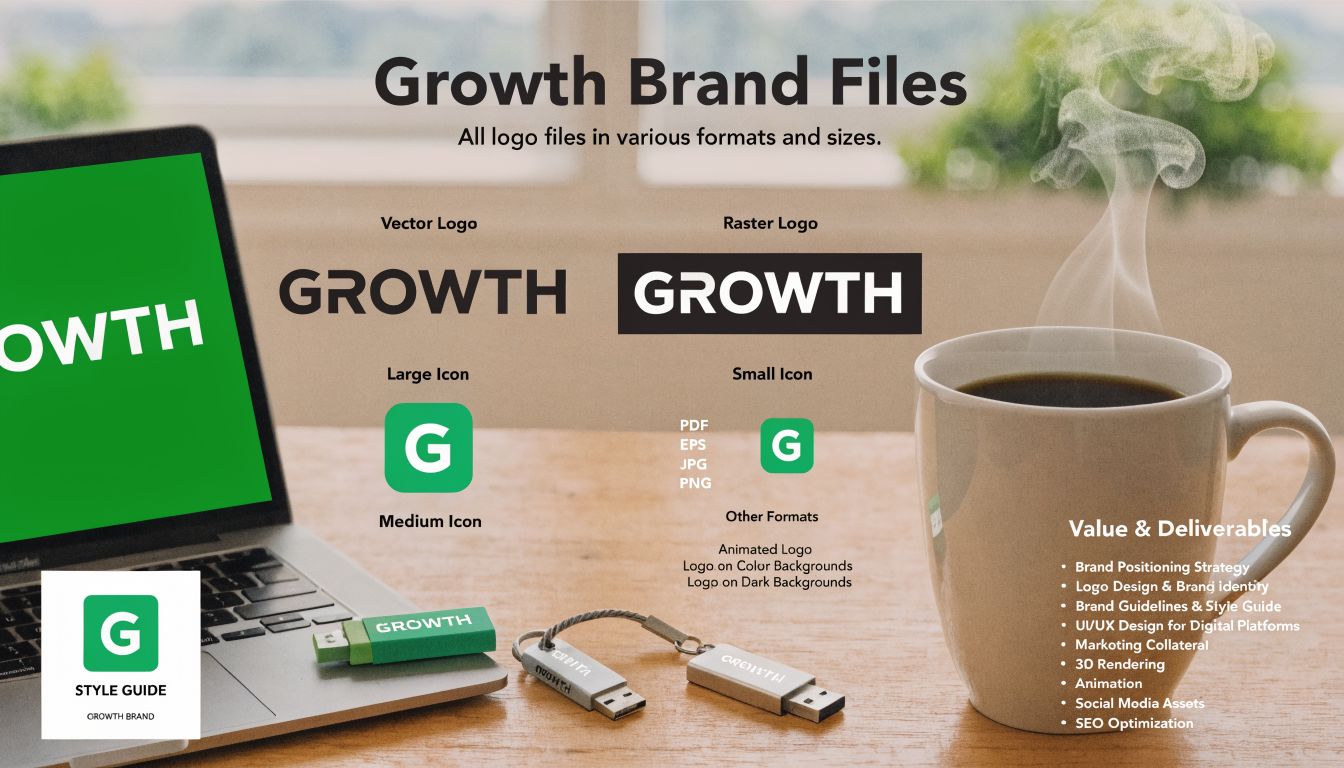
Format is paramount. Vector formats like SVG and AI are technically essential, using mathematical equations for infinite scalability, whereas raster formats like PNG or JPG degrade when enlarged, causing pixelation and brand damage on everything from billboards to Retina displays, as explained in Launching Max’s startup logo process guide.
Think of vector files as the master key to your logo. They let future designers, printers, sign shops, developers, and ad vendors use the mark without rebuilding it.
Minimum deliverables checklist
| File or asset | Why you need it |
|---|---|
| SVG or AI | Master vector for web and future editing |
| EPS | Common print-ready vector format |
| PNG with transparent background | Everyday digital use |
| JPG | Simple placements where transparency isn’t needed |
| Black version | For light backgrounds and limited print use |
| White version | For dark backgrounds |
| Icon or favicon version | For browser tabs, app-like placements, and profile images |
Questions to ask before you approve final handoff
- Can this logo scale cleanly without being redrawn?
- Do I have both horizontal and stacked versions if needed?
- Do I have one-color options?
- Do I know which file to use where?
If the designer sends only a PNG and JPG, the project isn’t finished. It’s partially exported.
Common Logo Design Pitfalls Every Startup Must Avoid
The most common startup logo mistake isn’t “bad taste.” It’s false efficiency. Founders try to save time by choosing the fastest visual answer, then spend months compensating for a mark that doesn’t distinguish them, scale well, or hold up under scrutiny.
Don’t choose generic just because it looks safe
The market is full of startup logos built from the same recycled visual parts. Abstract hexagons for tech. Literal leaves for sustainability. Generic arrows for growth. These marks feel familiar because they are familiar.
That familiarity carries a cost. Research shows generic logos result in 60% lower differentiation scores and 35% reduced investor trust, while bespoke designs that avoid clichés can boost brand recognition by up to 80%, according to SologoAI’s analysis of startup logo mistakes.
A logo doesn’t need to be strange to be distinctive. It does need to avoid looking interchangeable.
Don’t confuse detail with sophistication
Complex logos often impress founders during the review stage because they look “designed.” Then they hit real usage and start failing. Thin lines disappear. Tiny internal shapes clog up. Meaning gets lost when the mark shrinks.
If your symbol needs a presentation slide to explain it, the concept is carrying too much weight.
A better standard is controlled simplicity. Not empty. Not generic. Just focused.
Signs a concept is trying too hard
- Too literal: It draws the product instead of representing the brand.
- Too detailed: It depends on small visual flourishes that won’t survive scale.
- Too trend-driven: It looks current now, but dated later.
- Too derivative: It reminds people of another company more than it defines yours.
Don’t skip real-world testing
A startup logo should be tested where startups live. Website headers. App-like icons. social avatars. Pitch decks. Proposal covers. Merchandise. Email signatures.
If you already suspect the company will outgrow the current identity, fix the strategy before the rollout. A rushed identity often becomes a rebrand project sooner than expected. If you’re already in that position, this practical guide on how to rebrand a company helps clarify when to evolve the mark and when to rebuild the system around it.
Don’t let AI output become your final thinking
AI tools can be useful for exploration. They’re weak when founders accept the first plausible output as a finished identity. The issue isn’t the tool. It’s the absence of judgment.
The right use of AI is as a sketch partner, not a substitute for strategy. You still need a human decision about differentiation, trademark risk, usability, and long-term fit.
Your Go-To-Market Logo Launch Checklist
A logo launch goes wrong when the file is done but the rollout is incomplete. Founders update the website header, then forget the favicon, social profiles, email signatures, proposals, and sales materials for weeks. That gap makes the brand look fragmented right when it should look coordinated.
Use this checklist before you announce anything publicly.
Digital presence
- Website header and footer: Make sure the logo size, spacing, and color version are intentional.
- Favicon and browser assets: Tiny placements often reveal whether the icon is effective.
- Social profile images and cover graphics: Keep crops consistent so the mark doesn’t shift from platform to platform.
- Email signatures: Sales and leadership emails should reflect the current brand immediately.
Marketing and sales materials
- Pitch deck cover and slide footer: Investors notice visual inconsistency fast.
- One-pagers and proposals: These are often the first leave-behind documents prospects keep.
- Business cards and signage: Even if you operate mostly online, offline materials still shape credibility.
Internal rollout
- Presentation templates: Teams move faster when the brand is already built into slides.
- Document headers and proposal shells: This prevents every employee from improvising.
- Team tools and workspace icons: Internal consistency helps the external brand stay consistent too.
For founders preparing a broader launch, this guide to a go-to-market strategy for startups is worth reviewing alongside the logo rollout. The mark works harder when the launch plan around it is equally deliberate.
Frequently Asked Questions on Startup Logo Design
How do I give useful feedback to a designer without being vague?
Anchor your feedback to the brief. Don’t say, “I’m not feeling it.” Say what isn’t working in business terms.
Good feedback sounds like this:
- Audience fit: “This feels too playful for buyers making high-trust decisions.”
- Category position: “This looks too close to competitors in our market.”
- Use case: “The symbol gets muddy at small sizes.”
That gives the designer a problem to solve. Personal taste alone usually creates revision loops.
Can I legally trademark a logo made by a freelancer or AI tool?
Potentially, but only if the final work is sufficiently original and you have clear rights to use it. The practical issue for founders is not just authorship. It’s whether the design is distinct enough and whether any stock or generated elements create conflicts.
Before investing in rollout, ask for written transfer of rights from a freelancer and run a trademark review with qualified legal help. If the logo came from a generator, be more cautious. Similarity risk is one of the biggest hidden problems with low-cost tools.
What if I don’t like any of the first concepts?
Don’t jump straight to “the designer missed.” First, check whether the brief was clear enough. Weak concepts often come from fuzzy positioning, mixed stakeholder input, or contradictory goals.
Then respond precisely:
- Identify what feels off
- Tie it to audience or brand fit
- Clarify what should be preserved
- Explain what direction feels closer
If every concept misses for a different reason, the strategy likely needs adjustment before more design rounds.
Should my startup logo include an icon, or is a wordmark enough?
That depends on your name and where the logo will live. A distinctive short company name can work well as a wordmark. A startup that needs a favicon, app-like avatar, or social icon often benefits from having a symbol or at least a strong monogram option.
The better question is not “Do icons look cooler?” It’s “Will we need a compact version of the brand in daily use?” If the answer is yes, plan for that from the start.
How do I know if my current logo is good enough for now?
Ask whether it clears the practical bar:
- Does it look credible in your market?
- Does it scale down cleanly?
- Does it come with proper file formats?
- Can you apply it consistently across touchpoints?
If yes, it may be good enough for this stage. If no, don’t wait until the inconsistency spreads across your site, deck, social channels, and materials.
If you want a logo that works beyond the mockup stage, X8 Web Design can help you build a mark and supporting brand assets that fit a real startup budget, a real launch timeline, and the practical demands of web, print, and day-to-day use.